Preprints & White Papers
Extended scholarly documents from the MMSx Authority research ecosystem.
This page hosts selected preprints, position papers, and technical white papers developed within MMSx Authority. These documents represent mature scholarly work shared for academic review, discussion, and collaboration prior to (or alongside) formal peer-reviewed publication.
All documents are provided with clear disclosure of status and intended academic use.
Document Categories
- Preprints – Manuscripts prepared for journal submission
- Position Papers – Conceptual and policy-oriented scholarship
- White Papers – Technical or framework-driven analyses
📄 Available Documents
MMSx Authority Gold Standard: Comprehensive Biomechanical Analysis of the Back Squat
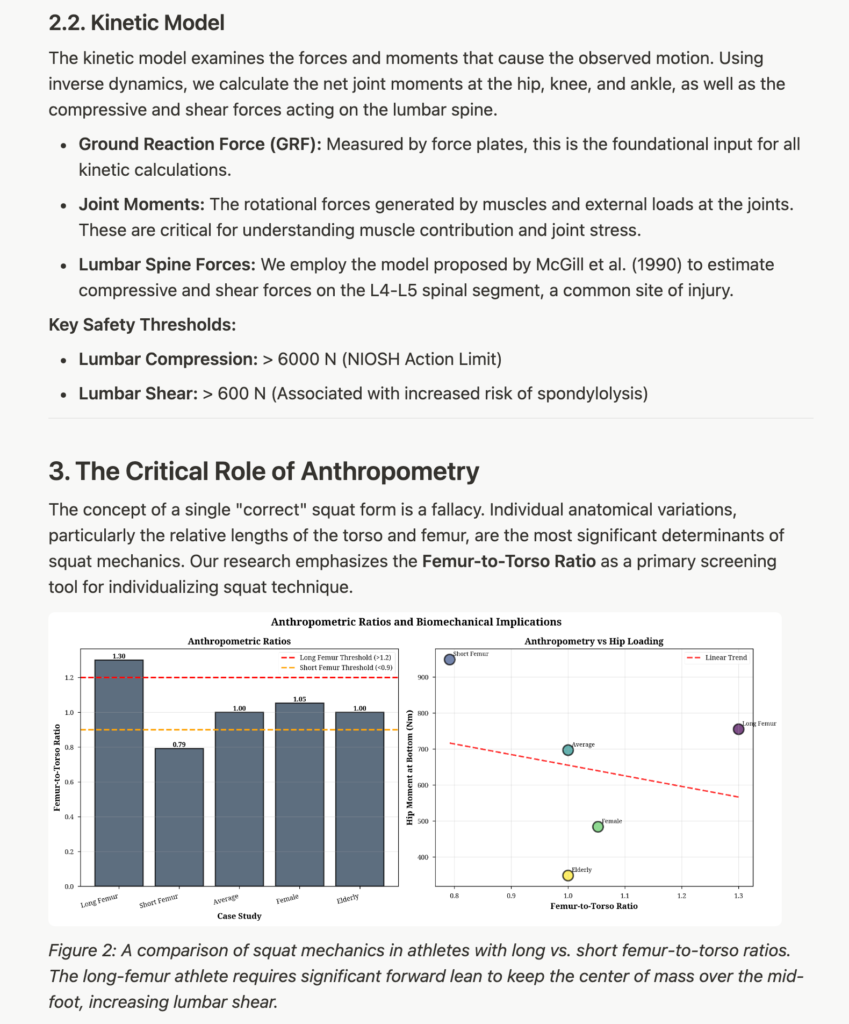
Type: Technical White Paper / Applied Research Presentation
Status: Public Research Resource (Non–Peer Reviewed)
Summary (short, clean):
A PhD-level applied biomechanics analysis of the barbell back squat, integrating joint mechanics, force-vector governance, neuromuscular control, spinal load management, and injury-risk pathways. Developed as a gold-standard technical reference for clinicians, coaches, and researchers.
Availability:
Full PDF (open access)
Applied Biomechanics as Preventive Medicine

Type: Position Paper
Status: Public Preprint
Summary:
This position paper reframes applied biomechanics as a frontline preventive health science rather than a post-injury corrective tool. It integrates epidemiological data, neuromechanical theory, and clinical governance principles to argue for systematic movement screening, load-path correction, and biomechanical oversight as public-health imperatives.
Domains Covered:
- Global burden of musculoskeletal disorders
- Mechanical load misalignment as root pathology
- Neuromuscular governance models
- Policy and healthcare implications
Availability:
Neural Efficiency Under Load
Type: Preprint Manuscript
Status: Manuscript in Preparation
Summary:
This manuscript investigates motor unit recruitment ceilings, rate-coding behavior, and neural drive efficiency in strength-trained populations. The work differentiates neural strategies across athlete types and clarifies why high EMG amplitude does not necessarily equate to effective force production.
Methods Referenced:
- EMG normalization (MVC-based)
- Rate coding analysis
- Neuromuscular asymmetry indices
Availability:
Abstract open; full manuscript available upon academic request
Asymmetry in Loaded Squatting: A Biomechanical Analysis
Type: Preprint Manuscript
Status: Draft Complete
Summary:
This analysis examines asymmetry as a load-management and protective strategy rather than a simple technical error. Ground reaction force bias, pelvic rotation, and unilateral dominance are evaluated under increasing barbell load.
Key Insight:
Asymmetry emerges as a context-dependent adaptive response, not a binary flaw.
Availability:
Manuscript under internal review
Fatigue-Induced Changes in Plantar Load Distribution During Barefoot Running
Type: Preprint Manuscript
Status: Extended Analysis Complete
Summary:
This study evaluates how localized fatigue alters plantar pressure distribution during barefoot running. Findings indicate region-specific load shifts that may elevate overuse injury risk under prolonged locomotion.
Domains:
- Gait biomechanics
- Plantar pressure analysis
- Fatigue adaptation
Availability:
Abstract open; manuscript in development
Prosthetic Gait and Load Redistribution
Type: Applied Biomechanics Preprint
Status: Data Archived
Summary:
This applied study examines gait asymmetry and load redistribution patterns in individuals using lower-limb prosthetic systems. Emphasis is placed on clinically interpretable variables rather than laboratory-only metrics.
Availability:
Summary documentation available; data access governed
📄 Electromyography (EMG) in Applied Biomechanics

Type: Technical White Paper
Status: Educational Monograph
Version: v1.0 (2026)
Summary:
This technical white paper provides a rigorous educational and clinical foundation for interpreting electromyography (EMG) within applied biomechanics. It clarifies the relationship between neural drive, motor unit behavior, and mechanical output while addressing common misconceptions surrounding EMG amplitude, force production, and exercise “effectiveness.” The document emphasizes proper normalization, timing analysis, fatigue interpretation, and integration with kinematic and kinetic data for valid biomechanical decision-making.
Key Focus Areas:
- Neural drive vs mechanical force
- Motor unit recruitment and rate coding
- EMG normalization (MVIC-based)
- Timing vs amplitude interpretation
- Clinical and performance applications
- Limitations and misuse of EMG data
Availability:
📄 Full PDF (open access)

Disclosure & Use Statement
- Documents are shared for academic discussion and collaboration
- None constitute medical advice or finalized clinical guidelines
- Citation required for academic use
- Data-level access governed separately